


The Department of Biology discussed a Master’s thesis entitled “The Impact of the Answer Sequencing Strategy on the Achievement of Second Intermediate Grade Students in Biology and Their Scientific Sense,” submitted by Mr. Ali Subaih Hassan Khalaf under the supervision of Professor Dr. Haider Maseer Hamdallah.
The study aimed to investigate the effect of the Answer Sequencing Strategy on improving the academic achievement of second intermediate grade students in Biology and enhancing their scientific sense, thereby strengthening their abilities in scientific thinking, analysis, inference, and evidence-based decision-making.
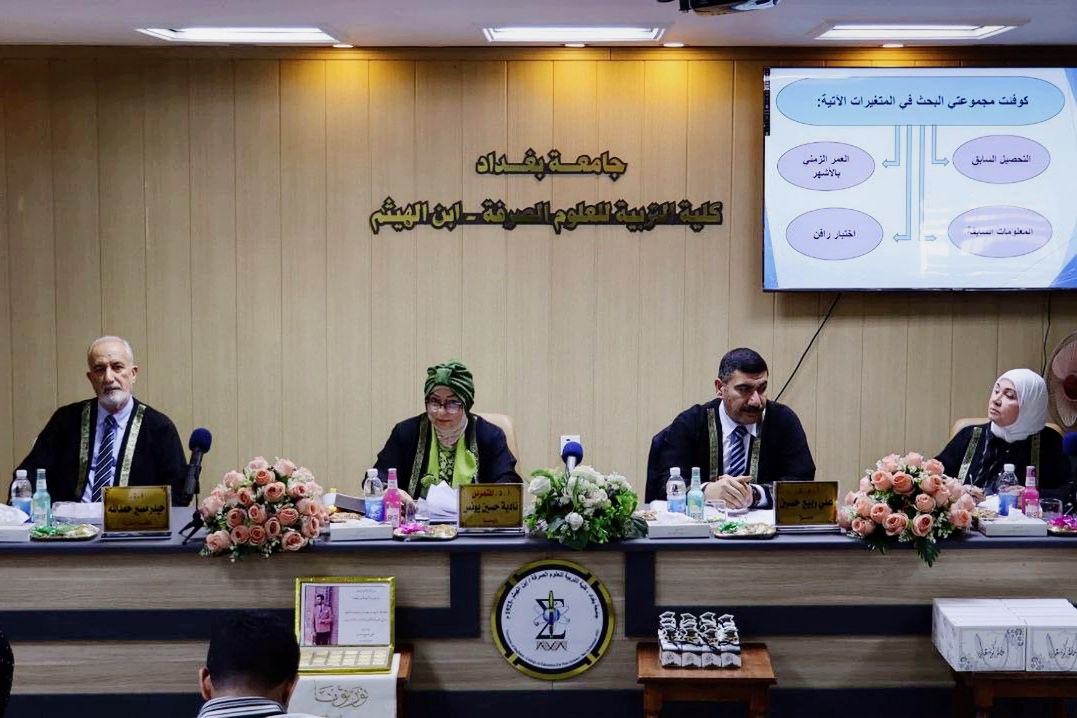
The examination committee consisted of Emeritus Professor Dr. Nadia Hussein Younis as Chairperson, Professor Dr. Sahla Hussein Qalandar as Member, Assistant Professor Dr. Ali Rabee Hussein as Member, and Professor Dr. Haider Maseer Hamdallah as Member and Supervisor.
The findings highlighted the importance of adopting modern instructional strategies that contribute to improving educational outcomes and fostering students’ scientific thinking skills in line with contemporary educational developments and quality education standards.
This research supports the achievement of the United Nations Sustainable Development Goals (SDGs), particularly SDG 4: Quality Education, through the enhancement of teaching and learning methods and the improvement of educational outcomes, as well as SDG 10: Reduced Inequalities by promoting effective learning opportunities and strengthening students’ scientific and cognitive competencies.
The present study aims to investigate the effect of the Answer Sequencing Strategy on the achievement of second-grade intermediate students in biology and their scientific sense.
The researcher adopted an experimental approach using a partially controlled experimental design with two groups: an experimental group and a control group. The study sample consisted of 68 students from Al-Jawadin Intermediate School for Boys, affiliated with the Directorate of Education, Baghdad / Al-Rusafa First, for the academic year (2025–2026). The sample was intentionally selected and divided into two groups: 34 students in the experimental group, who were taught using the Answer Sequencing Strategy, and 34 students in the control group, who were taught using the traditional method.
Equivalence between the two groups was established based on several variables, including prior achievement, chronological age (in months), prior knowledge, and intelligence as measured by Raven’s Progressive Matrices.
The instructional content covered the first four chapters of the prescribed biology textbook for second-grade intermediate students for the academic year (2025–2026). The researcher formulated 215 behavioral objectives, classified according to the first four levels of Bloom’s taxonomy in the cognitive domain: remembering, understanding, application, and analysis.
Additionally, 19 lesson plans were prepared for the experimental group based on the Answer Sequencing Strategy, and 19 lesson plans were prepared for the control group based on the traditional teaching method.
Two research instruments were developed and used:
Achievement Test: This test consisted of 40 items, including 36 multiple-choice questions and 4 essay questions, distributed across the four levels of Bloom’s taxonomy in the cognitive domain. To ensure face validity, the test items were reviewed by a panel of experts in science education and measurement and evaluation. A table of specifications was constructed to ensure appropriate content representation and distribution of items according to the relative weight of each chapter. The test’s psychometric properties were also established.
Scientific Sense Scale: This scale consisted of 40 items covering two domains: cognitive and affective. Its validity was confirmed through expert review.
The experiment was conducted during the first semester of the academic year (2025–2026), starting on Wednesday, October 1, 2025, and ending on Sunday, January 11, 2026, with two lessons per week. The researcher personally taught both groups.
After the completion of the experiment, the two instruments were administered to both groups. The students’ responses were scored and statistically analyzed using SPSS (Version 21).
The results revealed the following:
The results revealed a statistically significant difference at the 0.05 level between the mean scores of the two research groups, favoring the experimental group in both the achievement test and the scientific sense scale. Based on these findings, the researcher drew several conclusions and put forward a number of recommendations and suggestions for future research.
