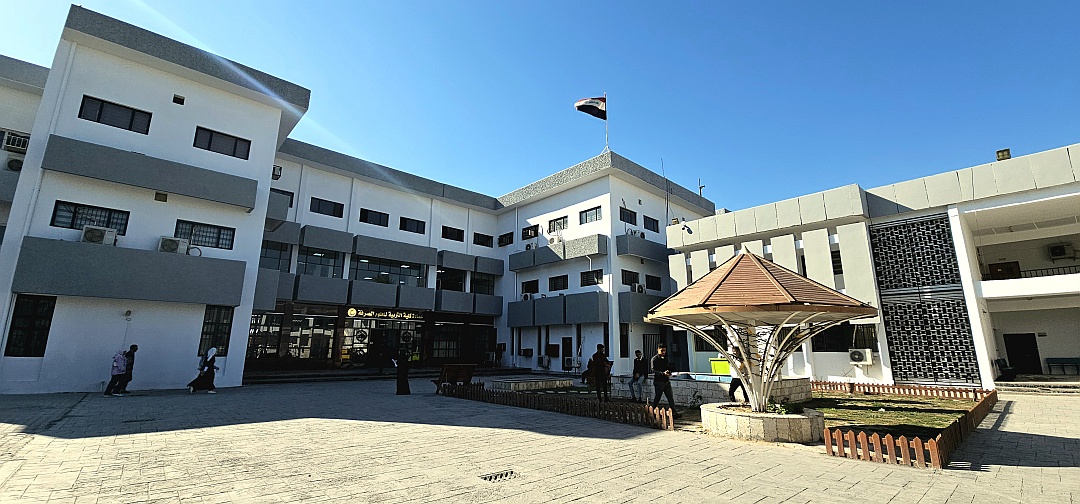
The College of Education for Pure Science (Ibn Al-Haitham) has achieved a distinguished academic milestone by becoming the first College of Education among Iraqi universities to secure program accreditation for all of its academic departments.
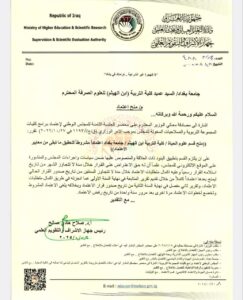
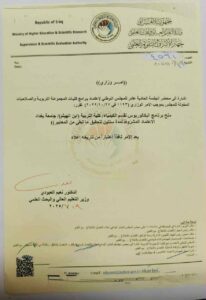
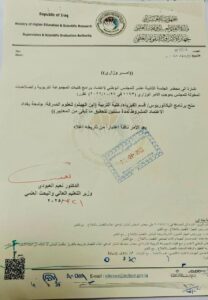
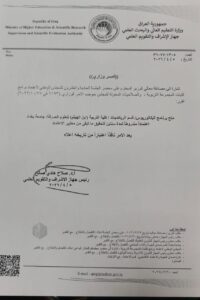
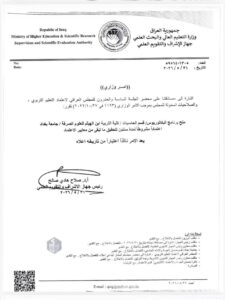
The Scientific Supervision and Evaluation Authority at the Ministry of Higher Education and Scientific Research has officially ratified the decision of the Iraqi Council for Accreditation of Teacher Education to grant the Bachelor’s Program Accreditation to the Department of Computer Science under Ministerial Order No. (1305-59564) issued on 31 May 2026.
With this achievement, all five academic departments of the College have now obtained program accreditation in the following chronological order:
Department of Biology
Department of Chemistry
Department of Physics
Department of Mathematics
Department of Computer Science
This accomplishment marks a historic achievement, making the College of Education for Pure Sciences the first College of Education in Iraqi universities whose academic departments have all successfully obtained program accreditation for their bachelor’s degree programs. It reflects the College’s firm commitment to academic excellence, quality assurance, and continuous institutional improvement.
Program accreditation is an official recognition that an academic program has undergone a comprehensive external evaluation and has demonstrated full compliance with nationally approved academic quality standards. It confirms that the program is capable of preparing graduates equipped with the knowledge, professional competencies, and practical skills required by their disciplines and the evolving needs of society and the labor market.
The accreditation further verifies that the College’s academic programs are supported by up-to-date curricula, qualified faculty members, appropriate laboratories and learning facilities, robust student assessment and learning outcomes evaluation systems, and effective mechanisms for continuous quality enhancement based on assessment findings, stakeholder feedback, and labor market requirements.
This achievement makes a significant contribution to the United Nations Sustainable Development Goal (SDG) 4 – Quality Education, by strengthening the quality of higher education, ensuring academic excellence, and enhancing learning outcomes. It also contributes indirectly to SDG 8 – Decent Work and Economic Growth through the preparation of highly qualified graduates, SDG 9 – Industry, Innovation and Infrastructure by fostering scientific and innovative capabilities, and SDG 17 – Partnerships for the Goals by promoting collaboration between higher education institutions, accreditation bodies, and relevant stakeholders to advance sustainable educational development in line with international quality standards.